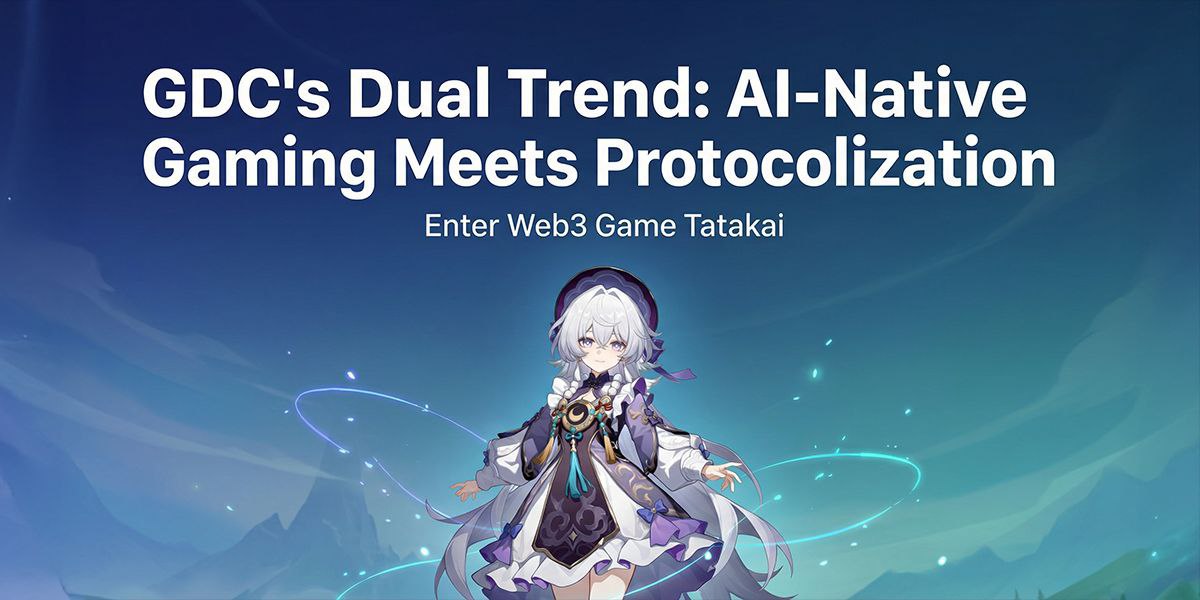
Hong kong, March 23rd, 2026, ZEX PR WIRE, Each year, the Game Developers Conference (GDC) highlights the ideas shaping the next phase of the gaming industry. While past conversations often focused on graphics engines or platform expansion, recent discussions have pointed to bigger structural changes in game design.
The trend is becoming increasingly clear: the rise of AI-native game worlds and the growing protocolization of game systems.
Games are evolving from static entertainment products into intelligent, persistent environments. At the same time, developers are beginning to separate the underlying mechanics of a game from the game itself, transforming them into reusable systems that can support broader ecosystems.
Tatakai sits at the intersection of these movements.
AI-Native Games: Worlds Shaped by Intelligent Systems
One of the most widely discussed topics at GDC has been the increasing role of AI in game development. Rather than manually scripting every character behavior or gameplay outcome, developers are building AI-driven systems that allow worlds to evolve dynamically.
AI-powered NPCs, procedural environments, and adaptive narrative systems enable games to react to player behavior in real time. Instead of following fixed storylines or predetermined sequences, players interact with systems that continuously generate new possibilities.
This shift marks the emergence of AI-native games—experiences where intelligent systems are embedded directly into the core gameplay.
Now, gameplay becomes more emergent. Player decisions influence the state of the world, while AI-driven systems adapt and respond to those actions. The result is a more organic form of interaction, where the game world behaves less like a scripted system and more like a living world.
Tatakai reflects this design philosophy by emphasizing interaction, strategy, and evolving environments. Rather than guiding players through fixed structures, the game encourages players to explore and influence a dynamic ecosystem shaped by both player behavior and system-level logic.
The Protocolization of Games
Alongside the rise of AI-driven worlds, another important shift is taking place: games are increasingly being designed as systems rather than standalone products.
In traditional game development, mechanics, economies, and interactions are tightly bound to a single title. But as games grow more complex and interconnected, developers are beginning to separate these mechanics into reusable frameworks.
This process, sometimes described as the protocolization of games, turns core gameplay systems into foundational infrastructure.
The idea is similar to how internet protocols enabled entire ecosystems of services. By abstracting core mechanics into protocols, developers can create things where new games, tools, or experiences build on shared foundations.
This approach is increasingly relevant in open and decentralized contexts, where interoperability and extensibility are essential.
Tatakai: A Game Built on a Protocol
Tatakai reflects both of these emerging trends through a dual-layer design: a playable game experience supported by Tatakai Protocol.
Tatakai Protocol represents the underlying framework that powers coordination, gameplay logic, and ecosystem interaction. Rather than being limited to a single game, the protocol provides a structure that can support future extensions and new experiences built on the same principles.
In this model, the game becomes the entry point, while the protocol represents the long-term infrastructure.
As the gaming industry moves toward AI-native systems and protocol-based design, projects that combine both layers may define the next generation of interactive worlds. Tatakai is not only building a game within that future. It is building part of the framework that could support it.